
The Future of Medicine: How Digital Twins Can Predict Your Health
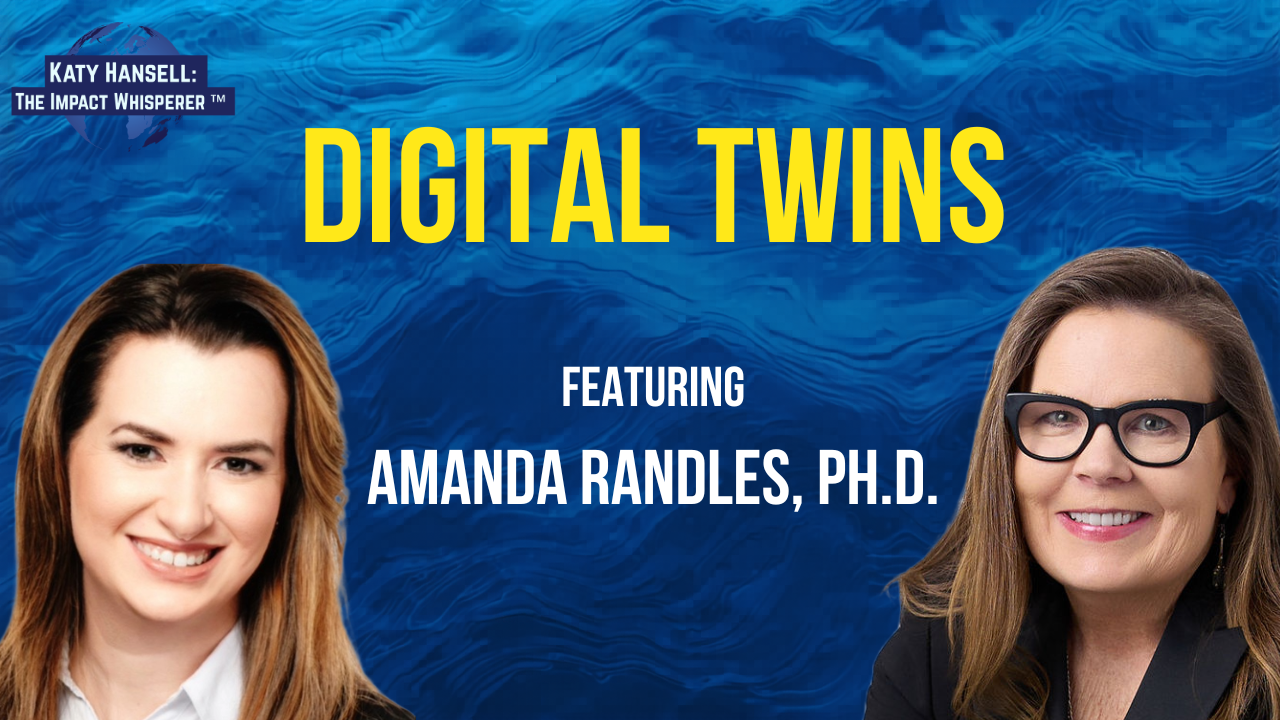
In this season 3 episode 9 of Katy Hansell: The Impact Whisperer® podcast, Creator/ Host Katy Hansell sits down with Professor Amanda Randles, Director of the Duke Center for Computational and Digital Health Innovation and Professor of Biomedical Engineering at Duke University, to explore how supercomputing, AI, and digital twins are transforming healthcare from reactive to proactive.
Amanda shares the story of how her career began at IBM, where working on the Blue Gene supercomputer sparked a realization: she didn’t just want to build powerful machines, she wanted to use them to improve human health. That early pivot led her from computer science and physics into interdisciplinary research spanning bioinformatics, fluid dynamics, applied physics, and biomedical engineering.
A major focus of the conversation is Amanda’s pioneering work in hemodynamic modeling—simulating blood flow through the human circulatory system. She explains how her lab moved from modeling a single heartbeat to creating longitudinal simulations, such as the Randles Lab longitudinal hemodynamic mapping framework (LHMF), that can now span weeks of blood flow activity, opening the door to new biomarkers and a deeper understanding of disease over time.
The episode also breaks down what a vascular digital twin is: a virtual, continuously updated model of a patient’s body informed by imaging, wearables, and other sensor data. Amanda describes how this approach can help clinicians find disease earlier, track progression in real time, and test treatment options before ever stepping into the operating room.
Katy and Amanda discuss the technologies powering this work, including HARVEY, the Randles Lab high-performance computing platform that runs large-scale fluid simulations, and Harvis, the extended reality interface that helps clinicians visualize and interact with complex 3D blood flow data. They also discuss HarVI the machine learning layer that lets doctors rapidly test “what if” surgical scenarios and see immediate predicted outcomes.
Amanda explains how AI is accelerating nearly every stage of the workflow—from automated image segmentation to reduced-order modeling to biomarker discovery—and how her center is bringing together researchers across cardiovascular disease, neurosurgery, rehabilitation, cognition, and more to build a broader digital twin of the human body.
The conversation closes with Amanda reflecting on what gives her hope: the pace of technological progress, the possibility of truly proactive healthcare, and the creativity of the next generation of students and researchers.
Creator/ Host Katy Hansell, aka The Impact Whisperer®, is a globally recognized (Top 10), award-winning expert impact coach, strategic advisor to founders, and Board Director, known for guiding 500+ clients across 3 continents to make the impact they care about. We feature top global voices, established and emerging Gen-Z leaders, who share how they advocate and activate for the people, causes, and communities that have captured their hearts! Please share and subscribe!
Closing thought:
This episode offers a compelling look at how computing power, AI, and human-centered design are converging to make healthcare more personalized, predictive, and empowering.
Chapters:
00:00 Introduction to Amanda Randles
03:16 Amanda's Moment of Impact
05:18 From Computer Science to Healthcare: Finding Her Path
08:44 Building an Interdisciplinary Career in Computing & Medicine
14:43 Can Technology Make Healthcare Proactive?
16:13 Amanda's Vision: Find, Track & Treat Disease
18:13 Using Fluid Dynamics to Predict Disease
20:35 Building 3D Models of the Human Heart
25:54 Digital Twins: The Future of Personalized Medicine
29:58 The Computing Power Behind Medical Digital Twins
33:50 Making Medical Simulations Faster & More Efficient
36:47 What Data Goes Into a Digital Twin?
42:19 Making Medical Data Easier to Understand
45:05 Could Doctors Test Surgeries Virtually First?
48:33 How AI Is Transforming Medical Digital Twins
54:08 Connecting Science, Technology & Healthcare
57:22 What Brings Amanda Hope
59:04 Closing Remarks
#biomedical_engineering #biomedicalresearch #digitaltwins #cardiovascularhealth